- Your cart is empty
- Continue Shopping



75.00 €
| Property | Details |
|---|---|
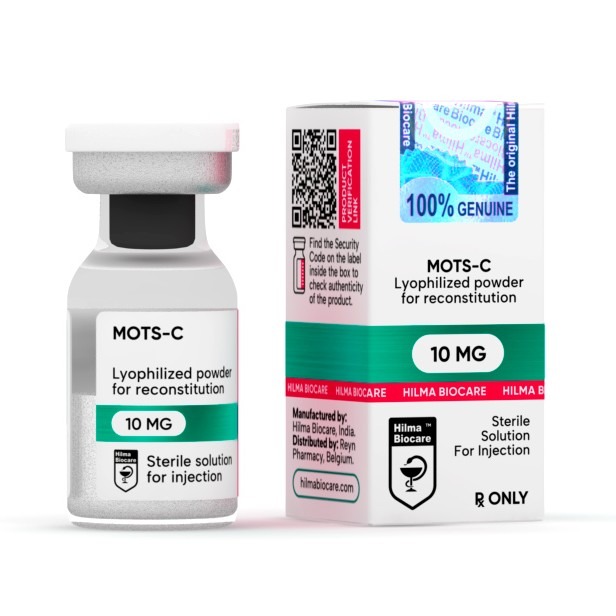
| Active Substance | MOTS-C (Mitochondria-Derived Peptide) |
| Dosage | 10mg per pen |
| Form | Injectable peptide pen |
| Brand | Hilma Biocare |
| Pen Yield | ~200 units (~1 month at standard dosing) |
Mots-C peptides you’ll come across were designed in a lab to mimic something the body already does. MOTS-C is different — it was discovered inside the body itself, specifically inside mitochondria, the structures inside your cells responsible for producing energy.
Dr. Ping Ling and his team at the University of Southern California found it there, which raised an obvious question: if the body makes this molecule naturally, what happens when we have more of it? That question drove years of research, and the answers turned out to be genuinely interesting.
MOTS-C is not a hormone. It’s not a growth factor. It’s a signaling molecule — something the body uses to coordinate activity across multiple systems at once. When mitochondria are healthy and functioning well, MOTS-C helps regulate everything from how you process sugar to how well you sleep. When mitochondrial function declines — which happens gradually from your mid-thirties onward — those signals get quieter.
There’s a tendency in the peptide world to oversell things — to list twenty benefits and hope a few of them stick. With MOTS-C, the research is specific enough that it’s worth being precise about what’s been studied and what was actually found.
Metabolism and blood sugar. This is where the evidence is strongest. Animal studies showed that MOTS-C improved how the body handles glucose and reduced systemic inflammation — two things that tend to deteriorate together as people age or become metabolically unhealthy. In diabetic mice, blood sugar regulation improved and body weight dropped. These aren’t minor effects — they suggest MOTS-C is doing something meaningful at the root of metabolic function, not just adjusting numbers on the surface.
Physical performance. A study published in Cell Metabolism looked at athletes specifically. The ones who received MOTS-C showed better muscle function and greater physical endurance than those who didn’t. The working theory is that by improving how mitochondria produce energy, the muscles simply work more efficiently — they get more output from the same input.
Sleep and cognition. This one surprised researchers. A five-day administration period was enough to produce measurable improvements in both cognitive performance and sleep quality in participants, according to a study in Nature Communications. Five days is not a long time, which suggests the effect is relatively direct rather than the result of slow accumulation.
Inflammation and aging. Chronic low-grade inflammation is one of the clearest markers of biological aging — and one of the hardest things to address directly. MOTS-C appears to reduce it, not by suppressing the immune system, but by improving the cellular conditions that drive inflammation in the first place.
The honest answer is: a fairly wide range of people, for different reasons.
Some are athletes who’ve hit a ceiling with conventional supplementation and want something that works at a deeper physiological level — not more protein or another stimulant, but a compound that changes how efficiently their cells produce and use energy.
Others are in their forties or fifties and are starting to notice that recovery takes longer, sleep isn’t as restorative as it used to be, and mental sharpness fluctuates in ways it didn’t before. For this group, MOTS-C is less about performance and more about maintaining function — keeping the systems that matter working the way they should.
There’s also a smaller but growing group of people who are simply paying attention to the longevity research coming out of institutions like USC and taking it seriously. They’re not waiting for mainstream medicine to catch up. They want to act on the best available evidence now.
None of these are niche profiles. Most people reading this will recognize themselves in at least one of them.
Rather than a glossy list of promises, here’s what MOTS-C research points to in plain terms:
Your metabolism works better. Your cells handle glucose more efficiently, which means less energy wasted, better body composition over time, and reduced risk of the kind of metabolic dysfunction that creeps up on most people as they age.
Your muscles perform better and recover faster. Not dramatically — this isn’t a steroid — but noticeably, especially if you’re training consistently and paying attention to how your body responds.
Your brain works more clearly and your sleep is deeper. These two tend to go together, and they both trace back to the same source: mitochondrial function and reduced neural inflammation.
Your body’s inflammatory baseline comes down. This one is slow and quiet but probably the most important in the long run. Chronic inflammation is behind almost every major age-related disease. Addressing it at the cellular level is worth more than most people realize.
MOTS-C has a clean record in the research published so far. No significant adverse effects have been reported at standard doses. The side effects that have appeared — very rarely — are mild: occasional headaches, brief nausea, or mild stomach discomfort. These typically appear when people use more than the recommended dose or ignore cycling guidelines.
That said, this is still an emerging compound. Long-term human data is limited. The right approach is to treat it with the same respect you’d give any active peptide — follow dosing guidelines, don’t improvise, and talk to someone medically qualified if you have specific health conditions.
If you’re pregnant or breastfeeding, this is not the right time. If you have an active or recent cancer diagnosis, consult your oncologist before using any compound with cellular-level activity. Anyone with known sensitivity to injectable peptides should proceed with caution and start at the lower end of the dosing range.
Standard dose: 50 units every 5 days One 10mg pen: Contains 200 units — roughly one month of use at standard protocol
The pen format makes dosing straightforward. You don’t need to reconstitute powder or calculate concentrations — the work is done. You select your dose, inject subcutaneously into the abdomen or thigh, and that’s it.
A few practical notes from people who use this regularly:
Rotate your injection sites. Using the same spot repeatedly causes unnecessary irritation. The lower abdomen is the most comfortable for most people — consistent, easy to reach, and minimal discomfort with a proper subcutaneous technique.
Don’t rush the injection. A slow, steady press of the pen gives a cleaner result than a fast one.
Take notes, especially in the first two weeks. MOTS-C’s effects on sleep and cognition can be subtle at first — the kind of thing you notice in retrospect rather than immediately. Keeping a simple log helps you calibrate.
Most people run 4–8 week cycles with an equal break in between. Some use lower doses on a longer-term maintenance basis for longevity purposes, though this is a personal decision best made with medical input.
Keep the pen refrigerated at 2–8°C before use. Once you’re actively using it, room temperature storage below 25°C is fine for the duration of the pen’s use. Don’t freeze it. Keep it away from direct sunlight. Standard rules — nothing complicated.
How is MOTS-C different from other peptides I might have heard of? Most peptides mimic hormones or growth factors. MOTS-C is a mitochondrial signaling molecule — it works at a more fundamental level, influencing how cells produce energy rather than stimulating a specific receptor. The range of effects it produces reflects that broader mechanism.
How long until I notice something? Sleep and cognitive clarity tend to show up first — sometimes within the first week. Physical performance improvements are more gradual, building over 3–6 weeks of consistent use. Metabolic changes take longer to measure meaningfully.
Can I stack MOTS-C with other peptides? Many people do — common combinations include Epitalon for longevity, BPC-157 for recovery, or Ipamorelin for growth hormone support. If you’re new to peptides, run MOTS-C on its own first so you know exactly what it does for you personally before adding complexity.
Is one pen enough for a full month? Yes. At 50 units every 5 days, a 200-unit pen covers approximately four weeks exactly.
Is this safe for long-term use? Current evidence doesn’t suggest safety concerns at standard doses. Cycling is the prudent approach — use it for a defined period, take a break, assess how you feel. This is standard practice with peptides generally, not specific to MOTS-C.
There are a lot of compounds out there making big promises. MOTS-C is not one of them — at least not in the way most people expect. It doesn’t produce dramatic, overnight changes. What it does is work at a level most compounds never reach: the actual machinery inside your cells that determines how well everything else functions.
If you’re looking for something that makes a noticeable difference in the background — better energy, better sleep, better metabolic health, less of the slow decline that most people accept as inevitable — this is worth your attention.
MOTS-C 10mg by Hilma Biocare is in stock and ready to ship. Add it to your cart and start the protocol this week.
Only logged in customers who have purchased this product may leave a review.


Reviews
There are no reviews yet.