- Your cart is empty
- Continue Shopping



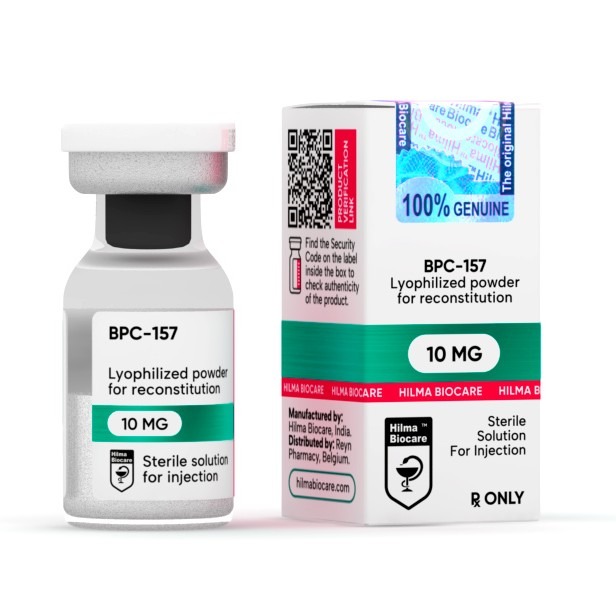
60.00 €
| Property | Details |
|---|---|
| Active Substance | BPC-157 (Body Protective Compound) |
| Sequence | Gly-Glu-Pro-Pro-Pro-Gly-Lys-Pro-Ala-Asp-Asp-Ala-Gly-Leu-Val |
| Form | Injectable (lyophilized powder) |
| Drug Class | Synthetic Pentadecapeptide |
| Brand | Hilma Biocare |
| Primary Use | Tissue repair, healing, anti-inflammation |
BPC-157 Hilma Biocare is not a trend — it is one of the most extensively researched peptides in modern regenerative science. Short for Body Protective Compound 157, this synthetic pentadecapeptide consists of 15 amino acids and is derived from a protective protein naturally found in human gastric juice.
What makes BPC-157 genuinely remarkable is the sheer breadth of its biological activity. Unlike compounds that target a single pathway, BPC-157 operates across multiple systems simultaneously — accelerating tissue repair, reducing inflammation, supporting angiogenesis, protecting the nervous system, and preserving gut integrity. All of this is supported not by anecdote, but by a growing body of peer-reviewed research published in internationally recognized scientific journals.
At the 10mg pharmaceutical-grade concentration provided by Hilma Biocare, you are getting a product built for real results — whether your goal is recovering from injury, protecting joints during heavy training, or supporting overall tissue health.
If faster recovery and real healing matter to you, this is the peptide you’ve been looking for. Order BPC-157 Hilma Biocare today.
This is where BPC-157 truly separates itself from the noise. The following benefits are supported by published, peer-reviewed research — not marketing copy.
Research published in the Journal of Applied Physiology demonstrated that BPC-157 significantly promotes tendon healing by stimulating tendon outgrowth, enhancing cell survival, and driving cell migration to the site of injury. A separate study confirmed that recovery of the Achilles tendon-to-bone unit following transection was meaningfully accelerated with BPC-157 supplementation — outperforming methylprednisolone in several functional recovery measures.
For athletes, strength trainers, or anyone dealing with chronic tendon injuries, this represents one of the most compelling applications of this peptide.
Multiple studies confirm BPC-157’s ability to accelerate wound healing far beyond the body’s natural rate. Research published in Drug Design, Development and Therapy showed that BPC-157 significantly enhanced healing of severe alkali-burn wounds both in live subjects and in isolated cell environments — promoting cellular proliferation, migration to damaged tissue, and formation of new blood vessels.
Further research in the European Journal of Pharmacology demonstrated that BPC-157 enhances granulation tissue formation and collagen organization during wound repair — two of the most critical factors in the quality and speed of tissue regeneration.
One of the most important — and often overlooked — aspects of healing is restoring adequate blood supply to injured tissue. Without proper vascularization, recovery stalls.
Research published in the Journal of Molecular Medicine identified that BPC-157’s pro-angiogenic effects are directly linked to the activation and upregulation of VEGFR2 — a key receptor governing the formation of new blood vessels. This mechanism explains why BPC-157 so effectively supports healing in tissue types that are notoriously difficult to repair, such as tendons, ligaments, and cartilage.
Chronic inflammation is one of the primary barriers to recovery — and BPC-157 addresses it directly. Studies examining its effects on experimental periodontitis in rats confirmed a significant anti-inflammatory response, with measurable reductions in inflammatory markers at the site of tissue damage.
This anti-inflammatory capacity makes it relevant not just for acute injuries, but for anyone dealing with persistent, low-grade inflammatory conditions affecting joints, tendons, or the gastrointestinal tract.
It was originally studied in the context of gastric protection, and this remains one of its most well-documented applications. Research has confirmed its interactions with adrenergic and dopaminergic systems in providing mucosal protection under physiological stress — making it a valuable compound for anyone dealing with gut inflammation, leaky gut symptoms, or stress-related digestive dysfunction.
Perhaps the most surprising dimension of BPC-157’s profile is its neurological impact. Research investigating traumatic brain injury in animal models found that BPC-157 produced significant neuroprotective effects — suggesting a role in protecting and potentially supporting recovery of neural tissue following injury.
Additional research has explored its modulation of dopaminergic pathways, with evidence that BPC-157 can influence neurochemical balance in ways relevant to mood, motivation, and stress response.
Research on engineered delivery systems for BPC confirmed meaningful antioxidant properties associated with the peptide — contributing to cellular protection against oxidative stress, a key driver of tissue aging and inflammation-related damage.
BPC-157 has attracted serious interest across a wide range of user groups, all for legitimate, research-supported reasons:
BPC has a notably clean safety profile in the existing research literature. No significant systemic toxicity has been reported at standard therapeutic doses in published studies.
Possible mild effects reported by some users:
Important: BPC has not yet completed full-scale human clinical trials. All existing research is predominantly preclinical (animal models) with some human observational data. Use responsibly and consult a healthcare professional before beginning any peptide protocol.
Route: Subcutaneous (preferred) or intramuscular injection Frequency: Once or twice daily, depending on protocol goals
Standard dosing range:
| Goal | Daily Dose | Frequency |
|---|---|---|
| General recovery & maintenance | 200–400 mcg | Once daily |
| Active injury / acute healing | 400–600 mcg | Twice daily |
| Gut health protocol | 250–500 mcg | Once daily |
Step-by-step injection guide:
Cycle length: Most protocols run 4–12 weeks, followed by a break of equal duration.
❓ What is BPC-157 used for? BPC-157 is primarily used for accelerating recovery from tendon, ligament, and muscle injuries, supporting gut health, reducing inflammation, and promoting wound healing. Its applications are backed by multiple peer-reviewed studies across these areas.
❓ How quickly does BPC-157 work? Many users report noticeable improvements in pain and mobility from tendon or joint injuries within 1–2 weeks of consistent use. Gut-related benefits are often reported within days. Full tissue repair outcomes build over a 4–8 week protocol.
❓ Is BPC-157 safe? Based on existing preclinical research, this product demonstrates a strong safety profile with no significant toxicity observed at therapeutic doses. However, large-scale human clinical trials are still limited, so responsible use with professional guidance is always recommended.
❓ BPC-157 vs TB-500 – which is better for healing? Both peptides support tissue repair but through different mechanisms. BPC-157 is more targeted toward tendon, gut, and neurological recovery, while TB-500 focuses more broadly on systemic tissue repair and flexibility. Many advanced users combine both for synergistic recovery effects.
❓ Can I use BPC-157 for gut health? Yes — this is one of the most established applications of BPC-157. Research confirms its mucosal protective properties and interactions with key gastrointestinal pathways, making it highly relevant for conditions involving gut lining integrity, inflammation, or stress-induced digestive dysfunction.
❓ How do I store BPC-157 after mixing? Once reconstituted with bacteriostatic water, BPC-157 should be refrigerated at 2–8°C and used within 28 days. Never freeze the reconstituted solution as this degrades the peptide structure.
The research is clear. The results speak for themselves. Whether you’re dealing with a stubborn injury that won’t heal, pushing through the demands of competitive sport, or simply investing in your long-term tissue health — BPC-157 Hilma Biocare gives you pharmaceutical-grade quality backed by over two decades of scientific investigation.
This isn’t a gamble. This is a calculated, evidence-based decision to give your body the tools it needs to repair, recover, and perform.
Only logged in customers who have purchased this product may leave a review.

Reviews
There are no reviews yet.